As early human settlements developed and were able to support non-agricultural specialization, a method was required to record basic information. Typically this occurred within the frameworks of religion and government.
Records were kept of inventory on tablets. Strokes for the number with pictures ('pictograms') of an animal or object.
Early civilisations were often sited near principal rivers and the indigenous reeds frequently used to mark clay tablets. A common approach was to cut the stem ends to wedges of different sizes to mark or produce indentations, as in cuneiform.
The next phase in linguistic development was the use of symbols to also depict sounds. Our Latin alphabet is a very straightforward implementation. The delay in the ability of western culture to read the 'lost' hieroglyphic script was, in part, due to the presumption that hieroglyphs, because of their quantity (more than 700 in frequent use and 2400 in total) must solely refer to objects (one of the first, ancient textbooks on hieroglyphs was completely mistaken in this belief).
The realisation that they were partly phonetic was made by the Frenchman, Champollion, after he studied the Rosetta Stone (an engraving of the edict of a pharaoh written in three languages, that included hieroglyphs).
His clue was the requirement for the Egyptians to write the Greek name, Cleopatra and which had to be spelt phonetically.
Whereas the English alphabet has 26 letters which are used phonetically, the Egyptians used symbols as both pictograms and phonograms.
Initially say, a picture of a rectangle was used to represent a house (prounounced 'per'). Later, the symbol was used to write part of another word that involved that sound.
The usual example here is if you need to write the word 'belief'. You could draw a picture of a bee and then a leaf = bee leaf.
The formal name for this is the rebus principle (rebus, Latin plural res, thing). Incidentally, the Egyptians thought that bees were the tears of the god Ra.
So, the language has a core alphabet of 30 symbols used phonetically together with a large number of pictograms (there are also phonetic symbols that represent not just a single consonant but two or three, bilaterals and trilaterals. An example is the heart symbol, a trilateral representing the three consonants n + f + r, pronounced nefer).
Note: The term pictogram is often confused with ideogram. Essentially they may be used interchangably but strictly pictograms are earlier symbols that have a likeness to the object they represent, ideograms have an abstract or conventional meaning and may not visually resemble the item or concept.
One other reason that it took so long to translate the hieroglyphs was that in writing their language the Egyptians only wrote the consonants and omitted the vowels (an unpointed language). Try, if you will, to translate 'th ct jmpd vr th mt', the cat jumped over the mat. Today when pronouncing glyphs it is typical to insert an 'e' for the omitted vowels as the actual proununciation has been lost (for those who need a quick definition of vowels and consonants, when you speak you expel air, if you also vibrate your vocal cords you are producing a vowel, if you obstruct the airflow, say with your tongue, you are producing a consonant).
Why omit the vowels? No, not laziness! In common with other Semitic languages such as Hebrew and Arabic, in Egyptian, vowels are pronounced differently depending on their context. So only the consonants were thought important.
One consequence of this is that many words had the same spelling. To clarify such situations, the Egyptians added another, silent, symbol at the end to indicate the intended meaning, a 'determinative'.
The use of the determinative is very common and is actually quite intuitive. Usually a fairly obvious symbol is used.
If the

(walking legs) symbol appears at the end of a group, you would be correct in surmising a connection with that action. To go, come, walk, run or enter are a few of the words it ends.
The symbols

each designate the occupations of men or women or I, me or my.
So we have

for brother and

for sister (Also note that the loaf of bread symbol

pronounced t, is the feminine ending in Egyptian).
Returning to the rectangle symbol

By itself it is the sound (phonogram) h
However, if combined with the stroke determinative

the representation is the object (house).
This is an important general rule, if you see the stroke determinative, an object not a sound is being represented. Perhaps the most common determinative was the sparrow. It is used to determine over 500 words connected with evil, pain and misery!
After Champollion published his 'Precis du Systeme hieroglyphique' in 1823 the script became accessible to the world for the first time in over 1500 years. The mystique associated with the symbols lessened. It had been such that the Romany people of Europe in medieval times, who had been viewed as having occult knowledge, were known as gypsies (a contraction of Egyptians) and the terms alchemy and chemistry (derived from the Arabic 'that of kem'; and 'kem', Kem being an ancient name for Egypt).
Time frame
Hieroglyphs were in use for over three thousand years. In part, the longevity of the Egyptian civilisation was imbued by the Nile, but whereas a written language in any culture has a tendency to change, hieroglyphs exhibit an unusual stability. One reason is that hieroglyphs were considered the language of the gods (hieroglyphs Greek, sacred writing) or more precisely, from Egyptian, 'the God's Words'.
However their civilisation never developed printing. In later eras, as the West harnessed technology and books became common, it was practical for knowledge to be easily recorded. Literacy (helped by a simple 26 character alphbet) became common. Science and industry developed..
In Egypt it took years to learn the symbols, and the skill was limited to a small elite, scribes (some psychologists contend that those languages with large numbers of characters that require many years of study inhibit creative development).
Hieroglyphic writing appeared in Egypt in about 3150 BC and was used until the Graeco-Roman period (the last known texts, found at Philae, date from the fourth century AD).
The chronology of ancient Egypt may be divided into 10 periods containing in total thirty one dynasties:
|
Date |
Period |
Dynasty |
|
Fourth millennium B.C. |
Predynastic period |
|
|
3110-2686
B.C. |
Protodynastic Period |
First to third dynasties |
|
2686-2181 B.C. |
Old
Kingdom |
Fourth to sixth dynasties |
| 2181-2040 B.C. |
First
Intermediate |
Seventh to tenth
dynasties |
| 2134-1786 B.C. |
Middle Kingdom |
Eleventh to
twelfth
dynasties |
| 1786-1570 B.C. |
Second
Intermediate |
Thirteenth to
seventeenth |
| 1570-1087 B.C. |
New Kingdom |
Eighteenth to
twentieth |
| 1087-716 B.C. |
Third
Intermediate |
Twenty-first to
twenty-sixth |
| 716-332 B.C. |
Late Period |
Twenty-seventh to
thirty-first |
| 332-30 B.C. |
Ptolemaic Greek
Period |
|
The hieroglyphs were mainly used for formal engraving and their aesthetic appearance was therefore important. There are no gaps between words and they are written from left to right, right to left or top to bottom. When looking at an engraving (a stelae), the orientation is gleaned from looking for a person or animal. If facing to the right, the glyphs are read from the right to the left. The symbols are always read from top to bottom within that semantic, so in figure 1 below of Cleopatra's Cartouche the interpretation is from left to right beginning with the 'chair' symbol.
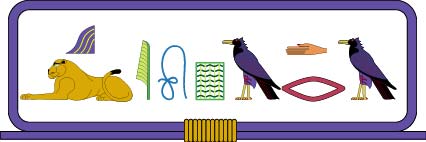
Figure 1. Cleopatra's Cartouche
The Rosetta stone was written in Greek, hieratic and hieroglyphic script. For daily use, it was time consuming to write hieroglyphs and the Egyptians used a cursive (joined) writing called Hieratic (Greek, hieratikos priestly). Towards the late 7th century BC, when the administrative centre for the country moved from upper to lower Egypt, hieratic was replaced by the demotic (popular) script. It, in turn, evolved under Greek influence, into Coptic.
As mentioned, Champollion's clue was the need to write the Greek name, Cleopatra, which had no Egyptian equivalent, and had to be spelt phonetically:
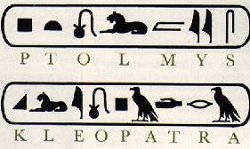
Figure 3. Cleopatra's Cartouche
On beginning to study hieroglyphs, a good starting point is the pharaohic names. The reason? It was the practice to write the name of the pharaoh inside a coil of rope, a cartouche (from the French soldiers who thought it resembled a bullet, the Egyptians termed it shenu). It represents the circle of life (probably from a mystical symbol called the Girdle of Isis, a cord around the waist, tied in a mystical knot).
It is the natural initial location when attempting to decipher an inscription.
Each pharaoh had five names. The early representation used for the Pharaoh was the 'Horus' name and consisted of the Horus falcon perched on a rectangle representing the Pharaoh as an earthly incarnation of the great sky-god. The rectangle was called a serekh and represented the Pharaoh's great house.
The two most important names were drawn within a cartouche, the nomen (family name) and the prenomen (coronation name). It is interesting to note that in Egypt royal succession followed the maternal side (the practical benefit that, in that period, the mother of a child was always known, had to be set against the resultant intrigues of court).
As we refer to our leaders with royal epithets such as 'royal highness', the Egyptians used a number of formal addresses for the pharaohs. These often appear before the prenomen and nomen cartouches. The most common consisted of the statement of rule over the two divisions of Egypt, upper and lower and consisted of the sedge plant and bee symbols,

The term Upper Egypt refers to the northern part where the Nile forms a delta, Lower Egypt is the southern part of the country (the Nile flows south to north).
The other common title was 'son of Ra':

You will encounter repetition of certain epithets in many inscriptions that will simplify your initial readings:
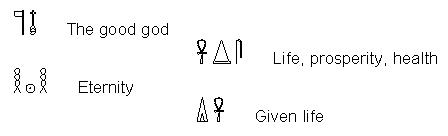
Names in Egypt were often linked to that of a deity. Rameses, a royal variant of Ramose was the conjoin Ra plus Mose (born of). Simple adjectives were also used, nefer (good or beautiful) or again conjoined: mutnefert (beautiful as Mut).
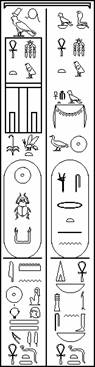
If we examine the stela, left, from Karnak, at the top left we have the Horus name, the rectangular serekh surmounted by a falcon. Next is the prenomen preceded by the sedge and bee

The symbols below translate, 'beloved of Amon-Ra, chief over the two lands'.
On the right side top are the vulture and snake goddesses Nekhebt and Wadjet. Each is depicted on the basket sign (Lord or Lady). Together known as the 'Two Ladies', the pharaoh invoked their protection as the female balance to Horus and Seth.
The falcon above the gold necklace is called the golden Horus name and is representative of the unchanging nature of kingship.
The nomen cartouche is, as usual, preceded by title 'son of Ra'

The symbols below that translate as 'given all life, stability and dominion, and all health'
The final Ankh with snake group at the bottom of both columns means 'living forever'.
Figure 4 The five great names of Senusert I
Returning to the types of symbols. Champollion identified a core of phonetic elements of the script, some thirty symbols that maybe used to represent sounds, phonograms:
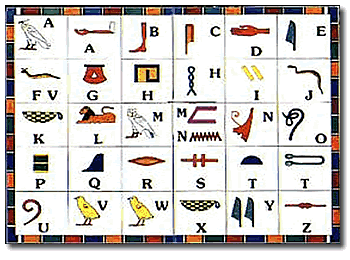
Figure 5.
It was mentioned earlier that the vowels were not written, so how is it that some are included in figure 5? The reason is that these are modern approximations
To copy glyphs is somewhat time consuming and a frequent practice is to use the above phonetic symbols as a 'shorthand'. The method of using the alphabet of one language to represent sounds in another is known as transliteration. A few additional characters are used to represent other sounds. An example is the cobra glyph, represented with a d
Ideograms and phonograms
In addition to the single consonants listed above, there are symbols that represent double or triple consonants (bilaterals and trilaterals).
There are about 130 bilaterals but just a handful are commonly used. Again, a bilateral or trilateral can often also represent an object.
Glyph Object Meaning Transliteration

Eye, do, make, ir
Face, upon, on account of, hr
Bilaterals

Water pots, foremost, hnt
Heart, beauty, nfr
Trilaterals
If a single vertical stroke determinative is seen under a symbol, it represents a thing or concept not a sound.
The fourth category of hieroglyph, the phonetic complement, applies to the bilateral and trilateral symbols. It is used to clarify the pronunciation of the omitted vowel.
The sedge plant glyph mentioned earlier is the bilateral sw, pronounced sew. If it is followed by the U symbol it could be read sw-w but it is still read sw but the pronunciation will have a different vowel sound.
The symbols for number are:
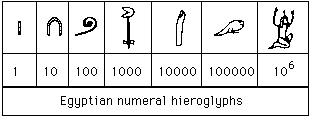
Figure 6. Numerics
Classification
The standard classification is the one set out by Gardiner. It allocates each sign to one of 26 categories (A-I, K-Z, Aa) and numbers each within that category.
The
sign is denominated O4, the
is D54
The sections:
A Man and his occupations
B Woman and her occupations
C Anthropomorphic deities
D Parts of the human body
E Mammals
F Parts of mammals
G Birds
H Parts of birds
I Amphibious animals, reptiles, etc
K Fishes and parts of fishes
L Invertebrata and lesser animals
M Trees and plants
N Sky, Earth, Water
O Buildings, parts of buildings, etc
P Ships and parts of ships
Q Domestic and Funerary furniture
R Temple furniture and sacred emblems
S Crowns, dress, staves, etc
T Warfare, hunting, butchery
U Agriculture, crafts and professions
V Rope, fibre, baskets, bags, etc
W Vessels of stone and earthenware
X Loaves and cakes
Y Writings, games, music
Z Strokes, signs derived from Hieratic, geometrical figures
Aa Unclassified
The sign-list detailed in his 'Egyptian Grammar' is quite extensive, a little over 100 pages (the grammar is 437 pages, the sign list 100 and the Egyptian-English and English-Egyptian vocabularies 80 pages).
Sir Alan Gardiner's canonic list is of those in use in the 'classic' Middle period and totals about 700. If a list were made of symbols from all periods (especially the Ptolemaic, when many were added) it would run to seven thousand.
Research
The advent of 'theoretical grammars' in Linguistics has given a depth to our understanding of how native speakers produce their language. The 'generative grammar' developed by Noam Chomsky suggests that phrases may be analysed in terms of a tree diagram:
S
/ \
NP VP
/ \
V NP
The phrase 'the cat bit the mouse' would have the noun phrase 'the cat' with the verb phrase 'bit the mouse' which in turn had the division of verb 'bit' and noun phrase 'the mouse' (the five sentence elements often suggested are: subject, verb, object, complement and adverbial).
Generative linguists hold that all are born with a universal innate linguistic knowledge in terms of rules.
As we learn a specific language we set 'parameters' (these are the differences which exist between different languages, say word order) to 'fine tune' our production.
It is further suggested that all sentences are composed of two levels of structure, deep structure and surface structure. It would seem to explain certain ambiguities, say: 'the chicken is ready to eat'. Here the two meanings are due to the two deep structures having the same surface structure.
The development of generative theory has produced several models with rule sets of how noun, verb and other sentence elements may be combined.
It would be interesting to investigate whether their application to modern language is also valid for the hieroglyphs (so implying that ancient Egyptian innate linguistic knowledge was the same as ours).
Metaphysics
Egyptian lore has it that the hieroglyphs were given to them by the ibis headed divine scribe Thoth.
The hieroglyphs were considered to represent more than just language but in certain situations the essence of a person or thing. As long as they were read, the item had existence. The practice of removing the hieroglyphs of a person was considered the obliteration of their continued existence.
The burial chambers in pyramids were 'decorated' with hieroglyphs detailing spells and prayers to aid the deceased in their journey to the next life, dubbed 'pyramid texts' by Egyptologists (the most complete are found inside the pyramids of the kings of the Fifth and Sixth Dynasties). Later they appeared on the mummies and other items within the burial chambers of nobles who had sought to use them. These were known as 'coffin texts'. Finally, when written on papyrus scrolls they took the generic name 'The book of the Dead'. The most complete belong to the Ptolemaic period, and contain about 150 spells (not chapters). It is also helpful to be aware that the Pyramid texts consist, in the main, of a list of items to accompany the deceased and can therefore be easily translated, in part, by breaking them down into the inventory of standard items.
In addition to the above, there are five theological works of some importance:
Book of what is in the Netherworld Describes the underground regions visited by the Sun god on his daily nocturnal journey (also known as the
Am Duat)
Book of Gates Descriptions of the underworld
Book of Caverns Descriptions of the underworld
Litany of the Sun Description of the destruction of mankind by Ra.
The gods of a nation tend to evolve to represent
their cultural sophistication.
The Egyptian gods were initially local deities that were consolidated or merged
much like modern companies. Alas not the romantic, mysterious objects conceived
of by many western readers. Initially each city had it's own creation mythology. Hermopolis had eight primeval deities, Memphis had Ptah crafting the world but perhaps the most influential were the creator-god Atum and the falcun headed sun god Ra of Heliopolis.
Late in the dynastic time-frame, the
Egyptian gods were incorporated into the Greek and Roman pantheons. Towards the end of the pharaohic period the monotheistic belief systems of Christianity, Judaism and
Islam supplanted the old gods. Finally, with the rush of science, for many,
religion ceased to be the best rationalization. Ironically, the philosophic tenant of
'burden of proof' now drives science to furnish the huge amount of explanation a
deity may need.
The Egyptian pantheon may economically be
summarized:
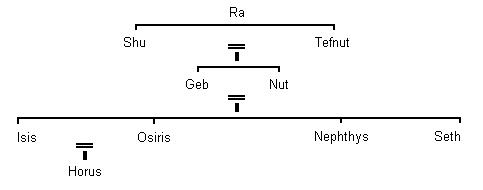
Many myths surround the above, and vary with geographical location and period.
One of the oldest, Amon (god of Thebes, a fertility deity), was 'joined' with Ra (the
sun god of Heliopolis) to form Amon-Ra.
Bastet, was a daughter of Ra (sometimes
said to be his sister and consort) whose cult originated in Bubastis, the
capital of a province of lower Egypt. Hathor, another daughter was thought to
have been the 'eye of Ra'.
Anubis, the son of Ra
(although later said to be the child of Osiris and Nephthys)
supervised the burial of Osiris and so became associated with funeral rites. He
is also said to have assisted in the judgement of the dead and is depicted with the head of
a jackal.
Isis was the Egyptian mother goddess who was
worshipped for more than 3000 years. Her cult later passed much of its imagery
to the virgin Mary. Isis resurrected her brother Osiris after he was killed by
his brother Seth. Osiris became god of the dead.
Horus was the son of Isis and Osiris, born after Osiris retired to the
underworld.
Horus is depicted with the head of a falcon.

Ra
Isis
Thoth
Amun
Horus
BIBLIOGRAPHY
Philip Ardagh The Hieroglyphs Handbook, London, 1999
Maria Carmela Betro Hieroglyphics The Writings of Ancient Egypt, New York, 1996
Ronald L. Bonewitz Hieroglyphics, London, 2001
Gardiner A.H Egyptian grammar, Oxford, 1957
Angela McDonald Write your own Egyptian Hieroglyphs, London, 2007
Barbara Mertz Temples, Tombs and Hieroglyphs, New York, 1964
Andrew Robinson The Story of Writing, London, 1995
Barbara Watson Introducing Egyptian Hieroglyphs, Edinburgh, 1993
Hilary Wilson Understanding Hieroglyphs, London, 1995
© 2020 C.I. Burkinshaw